
Local government region Interview
"Humanitude Regional Leader" Vol. 1: Yasunori Shimojima, who spreads "care techniques that convey kindness"
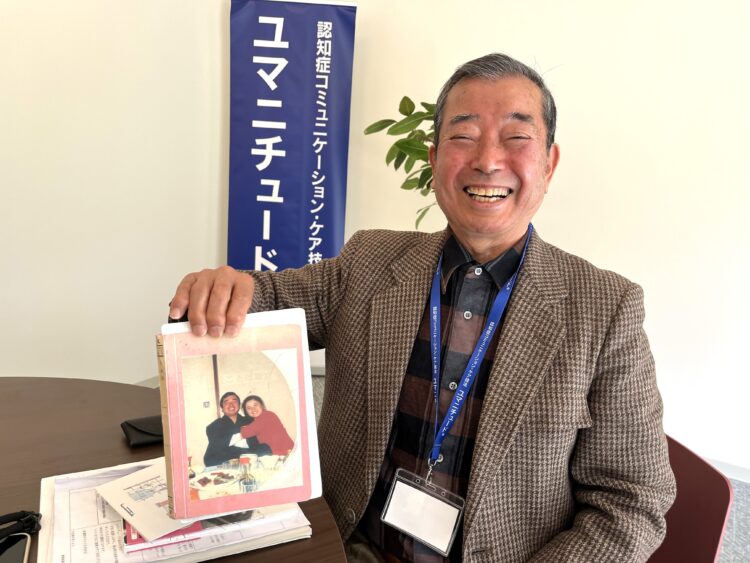
"Humanitude Regional Leader" Vol. 1: Yasunori Shimojima, who spreads "care techniques that convey kindness"
This time, we spoke with Ms. Shimojima, a member of the first graduating class of community leaders who is dedicated to spreading Humanitude in Fukuoka City. We asked her about her encounter with Humanitude based on her own experience in caregiving, and her passionate feelings about her activities in the community.
Three experiences I gained from caring for my wife
Mr. Shimojima has experience caring for his wife (Secchan). A friend pointed out that his wife's expression resembled that of an acquaintance who was depressed, and taking his wife to the hospital was the beginning of his journey into caregiving. The initial consultation was in 2006, but she was diagnosed with frontotemporal dementia in 2011. He says that three experiences during that uncertain period have greatly influenced his caregiving life.
(Shimojima-san)
"The first thing was deciding to commit to caregiving after speech with doctors and medical professionals. The second was knowing I wasn't alone in the face of uncertainty, which helped me emerge from the darkness. And the third was discovering Humanitude. By learning the philosophy of Humanitude, I was able to put myself in my wife's shoes and accept its techniques."
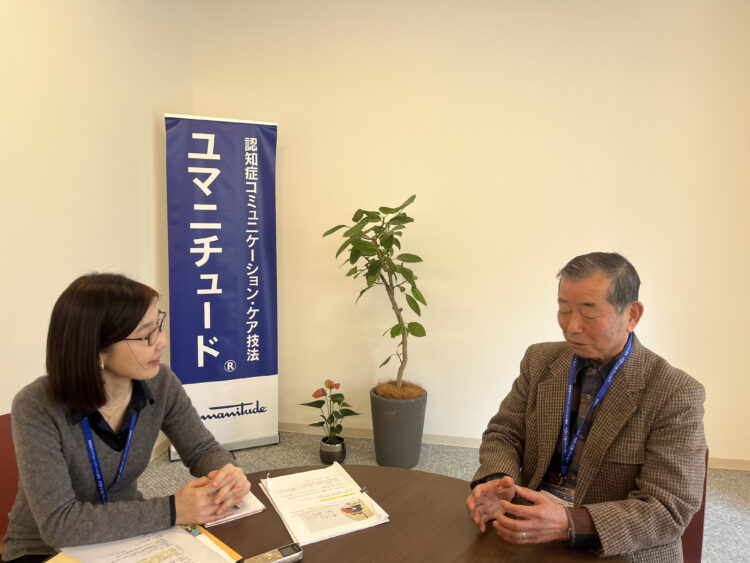
My encounter with Humanitude
I was struggling with caregiving when a friend from a family support group introduced me to Ms. Shimojima and Humanitude.
Initially, she attended the family caregiver training course out of a desire to save face for the person who introduced her, but when she saw a video of Gineste (the creator Humanitude) touching an elderly person's hand and easing their tension, she became interested, thinking, "Maybe I can move my wife's contracted hand."
(Shimojima-san)
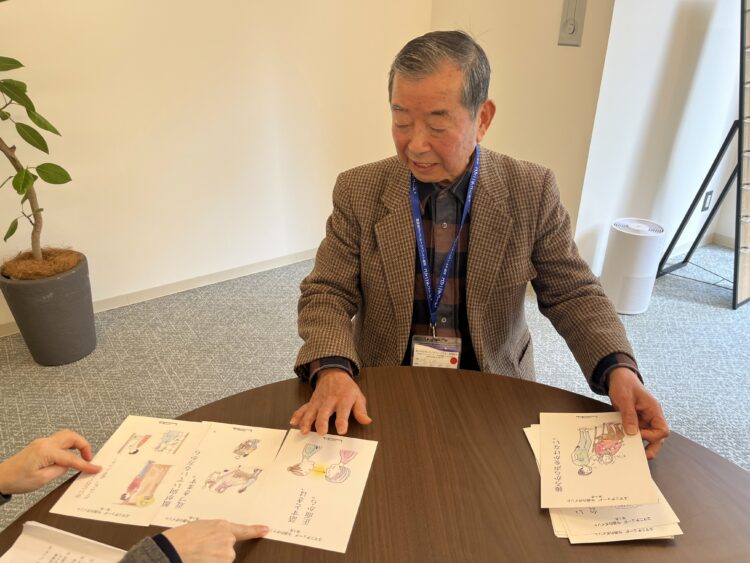
"After taking the course, I received one postcard each week for three months, each containing a technique from Humanitude. During the first month, I felt somewhat forced, thinking, 'Wow, this is tough. Do I really have to do the same thing every day?' But in the second month, I resigned myself to it and continued practicing. Gradually, I began to feel the effects, and by the third month, I was eagerly anticipating the next one."
And by the end of the three months, his thoughts had changed to, "I wonder if I can continue this longer." He said that by continuing to practice it, he became convinced that this wasn't just theoretical.
(Shimojima-san)
"What was particularly memorable was the card that said, 'When speech, look the other person directly in the eye.' When I have something to hide, I look away and can't look them in the eye at all. Then my wife looks away too."
Care techniques based on comprehensive communication
As a key aspect of Humanitude technique, Ms. Shimojima cites communication in situations where words are not spoken.
(Shimojima-san)
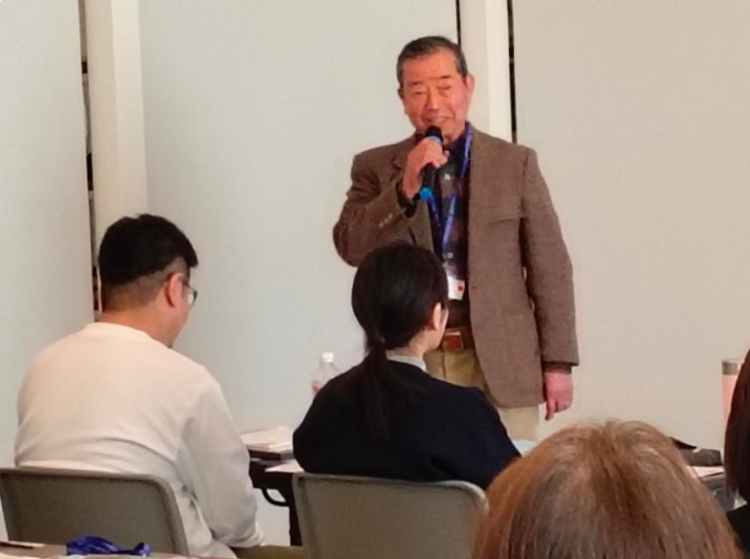
"Many people involved in caregiving say it's about 'compassion and support'... If they can communicate, you can convey things through words. But how do you communicate when they can't speak or can't talk? I found some clues to that in Humanitude."
"Learning the techniques of Humanitude allows caregivers to change and grow. I realized that by changing myself, caregiving became more successful. I thought, 'My wife is making me change.' As I changed, my wife's expression softened, and she looked relieved and happy."
Through the practice of Humanitude, Mr. Gineste came to our home to give us guidance, and the condition of my wife's contractures changed, and I myselfHe said he deeply realized the importance of being honest with himself and confronting his inner self.
"I want people to know as soon as possible"
She says that her strong desire to share this amazing technology with those in the early stages is what motivates her to work so energetically as Humanitude regional leader.
(Shimojima-san)
"With visits becoming difficult during the COVID-19 pandemic, and care for people with dementia becoming more challenging, I believe that Humanitude is an essential element for returning to the fundamentals of care, rather than just offering superficial words or empty gestures of compassion and support."
"Going forward, I want to dedicate myself to supporting people in the early stages of dementia, as well as motivated young people who may potentially take on caregiving responsibilities in the future."
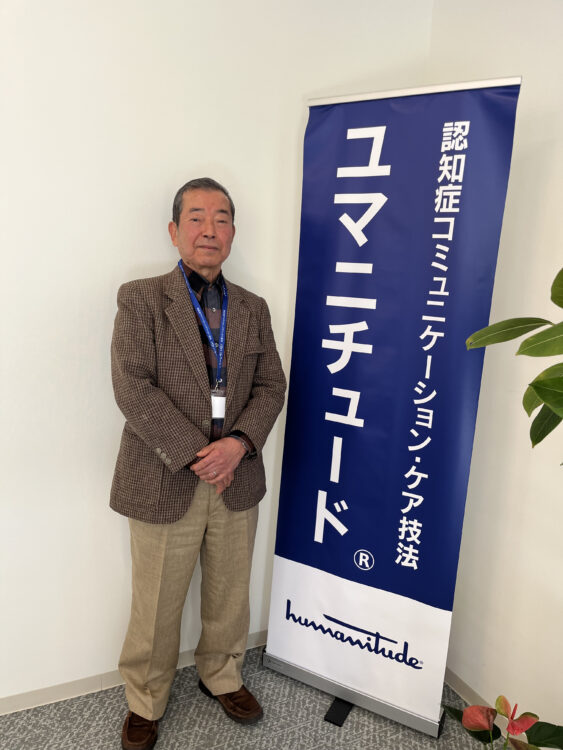
<Post-interview notes>
She showed me a photo she cherishes, a picture she took with her beloved dog, Secchan. She happily told me that she is planning a trip to Turkey soon, a place Secchan had always wanted to visit, and I was once again struck by the depth of their bond.