
Local government region Interview
"Humanitude Regional Leader" Vol. 4: Kaori Takahashi, who spreads "care techniques that convey kindness"
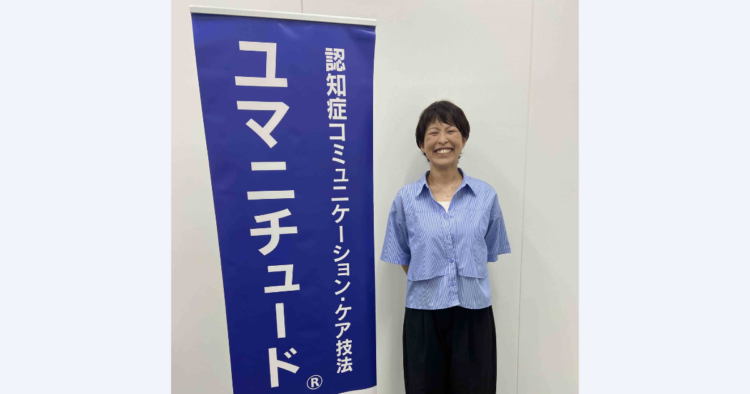
This time, we spoke with Kaori Takahashi, who works as a certified care worker at Minami Fukuoka Neurosurgery Hospital and became a Humanitude Community Leader (3rd generation) in March 2026, about her encounter with Humanitude and her thoughts as a community leader.
The entrance to the world of welfare and the obstacles I faced.
Ms. Takahashi worked in the wedding and funeral industry for 13 years. Witnessing the warm interactions between families and caregivers in the funeral department made her think, "What a wonderful job," which led her to enter the world of social welfare.
After that, she started her career as a caregiver at a day service center. She valued the spirit of hospitality she had cultivated in her previous job and interacted with the users, but she encountered a major obstacle when working with people with dementia. Faced with situations where she was asked the same questions repeatedly or where people strongly refused to bathe, she said she was deeply troubled, wondering if there wasn't a better way to interact with them.
(Takahashi)
"I kept asking myself whether I should keep giving thorough explanations, or if there was nothing I could do if they refused. That's when my husband, who is a nurse, asked me, 'Have you heard of Humanitude?' That was the beginning of everything. As I researched it myself, I felt, 'This is what I've been looking for!' I was also considering changing jobs at the time, so I decided to join my current hospital, which was founded with the philosophy of 'compassionate medical care' and made the practice of Humanitude one of its pillars. After completing my training, I began my journey as a practitioner."
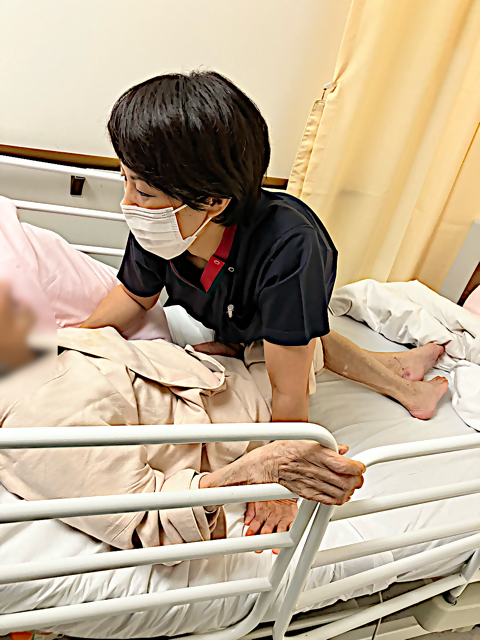
Takahashi communicates using Humanitude techniques.
The power of a "promise to reunite" that I realized at the hospital.
Ms. Takahashi studied Humanitude and has been practicing it with her colleagues at her current hospital.
Previously, when changing diapers, she would simply say, "I've come to change your baby's diaper," in a purely businesslike manner. However, after learning about Humanitude, her approach has shifted to one that focuses on building relationships with each individual baby.
He says there's an unforgettable incident that made him convinced of its effectiveness.
(Takahashi)
"About six months ago, I was in the care of a patient who was wearing an oxygen mask and barely breathing. As I was leaving the room, I casually said, 'I'll come to see you again,' and at that moment the patient exclaimed, 'Really?!' and opened their eyes and smiled happily."
I was shocked that, despite the lack of response to my previous attempts to get their attention, they responded so strongly to "I'll come see you again," one of the five steps in Humanitude—the promise to meet again.
Since then, I have cherished the five steps of Humanitude, imbuing every glance, every voice and word I use, and every touch with the hope that it will make people feel safe and secure.
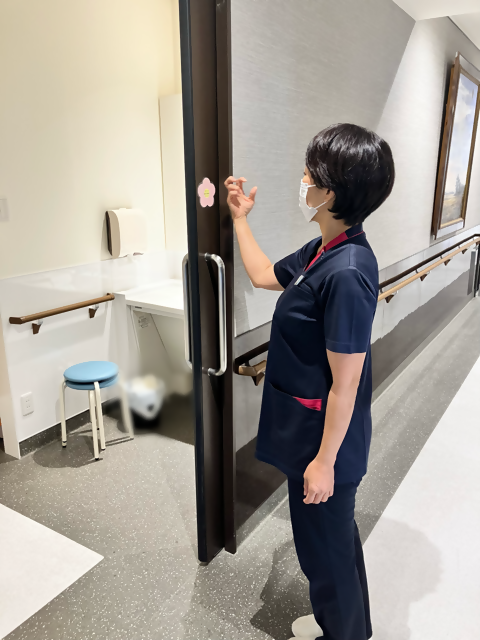
Takahashi is practicing the "knocking" technique as part of the five steps of Humanitude, "preparing for an encounter."
From player to guide—a new role of "communication."
Through repeated practical experience in the field, Takahashi began to harbor a certain thought.
It is a wish that the good relationships built through Humanitude during hospitalization will continue after discharge.
(Takahashi)
"We can build good relationships through Humanitude while patients are hospitalized. But I started to wonder what would happen after they were discharged and returned home or to a care facility."
Furthermore, she said there were many times when she felt frustrated seeing how the family members who came to visit were interacting with the patient, thinking, "If only they could interact like this, their feelings would be conveyed more effectively." However, it is not easy to give advice on the spot to families who are already overwhelmed with caregiving and treatment.
(Takahashi)
"I've always felt guilty about knowing about these things but not being able to share them. That's why I strongly felt the need to introduce these Humanitude techniques to people before they need care."
The desire to not let the successes and inspiring experiences gained in the hospital remain as treasures confined to the hospital, but to connect them to the bonds between the patients and their families, led to the decision to expand their activities into the community as a local leader.
Personalized care delivered to the community
Takahashi, who has only recently become a community leader, finds great fulfillment in her work as an instructor.
(Takahashi)
"My hope is that each participant will take away something that resonated with them. You don't need to memorize everything. I would be happy if you cherish what touched your heart."
He then added that he has something he wants to convey to the participants.
(Takahashi)
"Humanitude 's techniques of 'seeing,' 'talking,' and 'touching' are always centered on the relationship between the caregiver and the person receiving care. As you practice, you'll begin to see how to interact with each individual in a way that suits them, such as 'this distance is best for this person' or 'this person feels safe when you touch and talk to them firmly.'"
The quality and quantity of care you provide is always determined by the person in front of you.
I want to share the experience I gained in the hospital with the community and deliver the "skill of conveying kindness" to as many people as possible.
Mr. Takahashi spoke with a smile and passion throughout the entire conversation.
Each of her words conveyed her pride as a care worker who sincerely engages with patients and provides compassionate care. Going beyond the confines of the hospital, Ms. Takahashi's efforts as a community leader, expanding her connections within the community, will undoubtedly spread the wonderful benefits of Humanitude to many more people and create a warm and positive cycle around her.