
Interview
"Creating a Village, Not a Facility"—Ville Âge, a New Project Inspired by Humanitude on Réunion Island.
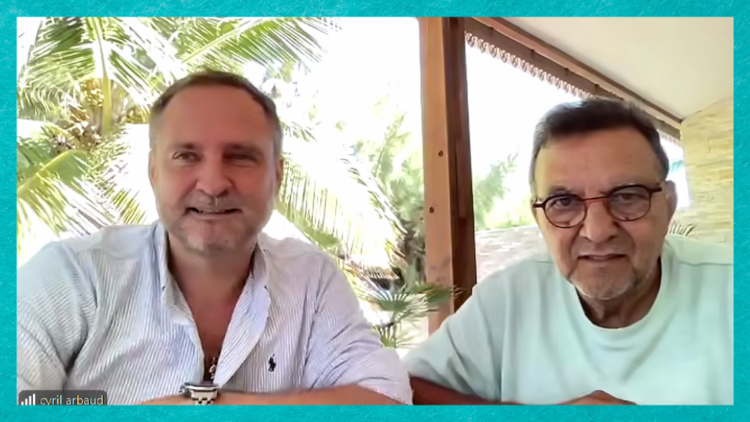
(Left) Cyril (Right) Joël, Head of Humanitude Promotion at Ville Âge
This time, we interviewed Cyril Albaud, one of the speakers at the "Humanitude Sans Frontières International Conference" to be held in October.
We spoke with Cyril Arbaud, founder and director of "Ville Âge," a senior living project underway on the French overseas department of Réunion Island, about the project's origins, his thoughts on Humanitude, and his vision for the future. We explore this challenge of creating a new kind of community that is neither a senior living facility nor a hospital.
The challenges of an aging population faced by the French overseas department, Réunion Island.
—First, could you tell us about the current situation and challenges on Reunion Island, where the project is set?
Réunion Island, a French overseas department in the Indian Ocean, is an island with a population of approximately 1 million and is currently experiencing a period of rapid population aging. While the population aged 75 and over is projected to increase significantly in the future, elderly care facilities (EHPADs) are already at full capacity, forcing many people to wait for admission.
Therefore, there are not enough options available to support those who find it difficult to live at home. The lack of suitable housing options to bridge the gap between home and care facilities is a major challenge on Reunion Island.
Having been involved in the operation of elderly care facilities for many years, I have come to feel the need for a new living environment that can address these challenges.
Furthermore, current elderly care facilities are structured in a way that requires substantial construction and maintenance costs, often placing a heavy burden on residents and their families. Therefore, rather than the buildings themselves, we wanted to create a system where more resources can be invested into what is truly important: the "quality of daily care" and the "enrichment of staff."
My encounter with Humanitude, and my dream of "creating a village, not just an institution."
—Why did you decide to launch a new project?
I have been working in the fields of elderly care and medical welfare for over 20 years.
Furthermore, because I grew up in a senior care facility where my father was the director and my mother was the activity coordinator, caring for the elderly was a part of my daily life from a young age.
Although I'm from Switzerland, I encountered Humanitude through a documentary shown in class while I was a student studying in mainland France, and I was deeply impressed.
Later, when I was posted to Réunion Island, I strongly reached out to Yves Gineste, who co-founded Humanitude alongside Rosette Marescotti, and had him conduct a training session for us.
During the training, Mr. Gineste asked me, "Who is the director here?" When I raised my hand, he showed me how prioritizing organizational convenience, such as the daily use of wheelchairs, can sometimes rob people of their abilities and turn the organization into a "factory that creates dependence." That day, I was deeply shocked to realize that choices made to support the elderly could, in the end, lead to a loss of autonomy. Since then, as a director, I have made it a point to prioritize "people's happiness, autonomy, and freedom" above organizational efficiency and financial considerations when making decisions.
This happened more than 20 years ago, but it was an experience that fundamentally changed the way we provide care.
Since then, I have continued my efforts to spread Humanitude across the island. While serving as the operations manager for Réunion Island's largest network of facilities and services for the elderly and family caregivers. I also promoted its implementation in several elderly care facilities and assisted in obtaining Humanitude certification. While Humanitude significantly changed on-site care, I also began to feel that there were limitations to what could be achieved within the framework of existing facilities.
Humanitude taught me the importance of "putting the person first." This means respecting a person's abilities, will, and life rhythm.
Gradually, I began to think, "Could this way of thinking be extended not only to care settings, but also to homes and communities themselves?"
I have a dream.
It's about going beyond the framework of a facility and creating a community (village) based on the principles of Humanitude. Even as people age or develop dementia, they wish to remain members of society. That's why we wanted to create a place where people's freedom and dignity are protected, and where they can continue to live normal social lives, rather than the hospitals and facilities that exist today. The new community born from this idea is "Ville Âge."
A new lifestyle option that is neither home nor institutional care.
—What kind of living environment specifically does Cyril envision for "Ville Âge"?
The concept is that "it is a village, not a facility" Ville Âge aims to be a new and unprecedented "intermediate housing" that primarily targets independent or semi-independent elderly people, and also provides a dedicated area for those with mild to moderate cognitive impairment.
The accommodations are approximately 45 square meter "private lodges" equipped with barrier-free facilities, and can accommodate couples. Regarding care and medical services, we envision a system that allows residents to receive services in a manner similar to their own homes, in collaboration with local medical and nursing professionals, thus balancing safety with independent living.
Furthermore, the village center will feature cafes, restaurants, grocery stores, beauty salons, a multi-purpose hall, and a vegetable garden. The plan is to create an environment where natural interactions can occur in daily life.
Furthermore, the various facilities within the village will be open to local residents as well. The aim is to create a living environment where people of all generations, from children to the elderly, can interact on a daily basis, rather than creating an isolated space for the elderly.
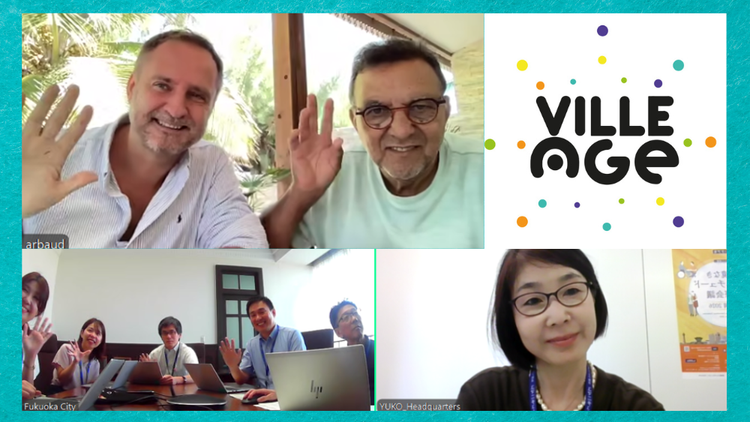
Humanitude from "care" to "community"
—What role does Humanitude play within Villeage?
Humanitude is not just a care technique.
At Ville Âge, we strive to reflect the principles of Humanitude in all aspects of our work, from architecture and management to building relationships with the local community.
At its core is the idea that, rather than asking people to adapt to the environment, the environment itself should be designed to suit people.
Furthermore, they are proposing a "village council" concept as a mechanism that allows residents themselves to participate in community management. Creating an environment where residents can live with a sense of purpose and responsibility aligns with the philosophy of Humanitude.
From Reunion Island to the world
—What message would you like to convey to everyone at the international conference in October?
Currently, we are working on securing land, funding, and administrative conditions for the development of the first village, and the opening date will be decided on the premise that these preparations proceed smoothly.
In addition to its village development projects, Ville Âge aims to expand its international cooperation in supporting people with cognitive impairments. Through collaboration with elderly care facilities in Madagascar and home care support organizations in Mauritius, we hope to support caregivers and supporters by sharing knowledge and practical experience based on the principles of Humanitude.
We want to expand communities based on the principles of Humanitude across national borders, and deliver a system where everyone can live with dignity, even in regions with different infrastructure and cultures.
I am truly looking forward to sharing with you all our challenges in building the communities of the future at this international conference.
[Editor's Note]
Cyril concluded with the following words:
"Protecting a person should not mean taking away their freedom."
This phrase perfectly encapsulates the philosophy of Villeage.
Even in old age or with dementia, people will continue to live in their communities as individuals. Not as those who need to be protected, but as people who choose to live, participate, and connect with others. A challenge to realize this is about to begin on Réunion Island.