
Interview
Humanitude is spreading in Singapore's super-aging society: Taking on the challenge of creating a community-based care system.
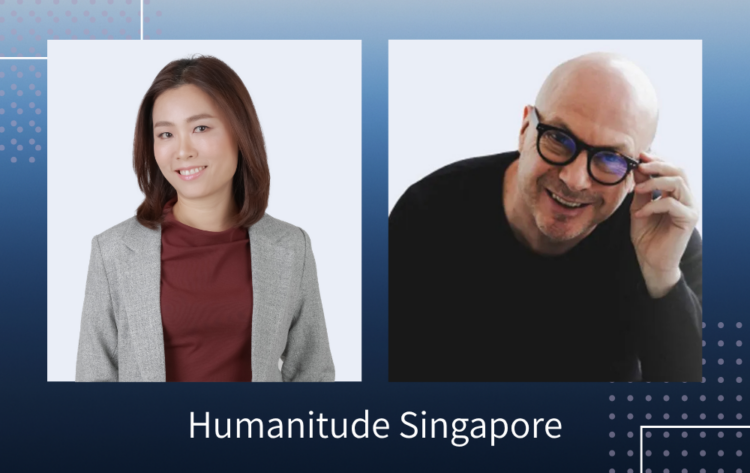
(Left) Ms. Sirana (Photo courtesy of Ms. Sirana)
(Right) Mr. Franck (Source: Humanitude Singapore website https://www.humanitudesingapore.com/about)
This is the second installment of the "Humanitude Sans Frontières International Conference" speaker interviews held this month in Fukuoka City. This time, we spoke with Sirana Tinmanee (hereafter, Sirana) and Franck Dibouës (hereafter, Franck), co-founders and directors of "Humanitude Singapore," which is driving the spread of Humanitude in Singapore's rapidly aging population.
We will introduce our efforts to create a sustainable Humanitude, including a unique implementation model tailored to Singapore's regional characteristics and initiatives for institutionalization through collaboration with government agencies and local care organizations.
Singapore, a leading country in aging populations: Steps toward the spread Humanitude
—What prompted you to introduce and spread Humanitude in Singapore?
(Franck)
Previously, as a clinical psychologist, I conducted training for staff at nursing homes and hospitals in France. During that time, I was deeply impacted by the numerous comments I heard from trainees who had studied Humanitude, such as "My life has changed" and "I've become a better person." From there, I became interested in Humanitude and deepened my understanding of it.
After that, I moved to Singapore and witnessed firsthand the current situation in Singapore, where the population is aging rapidly, just like in Japan.
Convinced that" Humanitude 's care techniques can solve Singapore's aging challenges," we started our activities in 2019.
(Sirana)
Singapore is a small country with a population of about 6 million, but it is aging at a speed that rivals Japan's.
Humanitude Singapore currently operates with a team of five people: Franck is in charge of overall strategy and innovation, and I am the head of communications and a trainer. There are four certified trainers on the team, including myself, and furthermore, certified trainers are being trained at the healthcare and nursing care facilities where we have provided our training, and are actively working in the field.
Since its inception in 2019, we have provided training to approximately 1,500 healthcare and nursing professionals. To date, we have conducted training at 15 healthcare and nursing institutions, and many of these facilities continue to practice Humanitude.
Four pillars for creating a sustainable ecosystem.
—Could you tell us about your main activities that you are currently involved in?
(Sirana)
Through our continued work, we've learned that promoting Humanitude isn't simply about increasing the number of people taking training courses. What's important is creating an environment where Humanitude can be continuously practiced within local care systems. Therefore, we focus our activities on the following four pillars:
- Improving local responsiveness and fostering future leaders
- Training and implementation support for nursing care facilities
- Collaboration with local communities and information dissemination
- Building quality assurance and sustainable operational systems
Currently, we are collaborating with a major elderly care facility group and are working on a project with the goal of having "more than 60% of the staff at six facilities participate in training within three years."
We also work closely with the Agency for Integrated Care (AIC), a government agency that oversees elderly care services and supports caregivers. Two years ago, we received funding from the AIC and conducted a pilot training program in collaboration with them. Currently, based on the results of that program, we are holding discussions to incorporate "Humanitude" training into the government's standards for evaluating the competency development of care staff.
Towards a "unique implementation model" tailored to national systems
—What was the biggest challenge in spreading and promoting Humanitude?
(Sirana)
The biggest challenge is to maintain the ideals and quality of Humanitude while harmonizing and positioning Humanitude within Singapore's systems and healthcare and caregiving personnel training framework.
Many facility directors and managers have expressed great interest, saying, "Humanitude is truly wonderful, we definitely want to implement it!" However, in busy workplaces where priority tasks often conflict, securing training time and introducing new projects is not easy.
Furthermore, while many foreign staff members from Myanmar, the Philippines, India, and other countries are active in community-based care settings, the current national training subsidy system has limitations, creating a challenge where facilities face significant costs when providing advanced and specialized training to foreign staff. Overcoming these two barriers of "time" and "funding" is our biggest challenge, and we are still working to solve this problem.
—How are you currently dealing with those difficulties?
(Franck)
We are currently redesigning our training curriculum in detail to adapt it to the Singaporean system without compromising the essence of Humanitude care, and to overcome the challenges of staffing shortages.
Specifically, we are considering offering Humanitude 's competency standards in two levels: "basic level" and "intermediate/advanced level," in line with the competency development evaluation standards set by the government. For foreign staff, who face significant financial burdens, we plan to create a system that allows them to gradually progress from an introductory course, which is shorter than the original training, and to voluntarily choose and take the next step required to obtain a certificate of completion. On the other hand, for intermediate and advanced level staff, who do not have financial problems, we intend to encourage them to participate in the original four-day training, whose optimal effectiveness has already been proven.
Thus, making flexible adjustments to suit the national system and local conditions requires considerable effort. However, it is an essential undertaking for establishing Humanitude in this country, and we believe this is our important role.
Proven results and real changes happening on the ground.
—What kind of results have you actually seen since implementing Humanitude?
(Sirana)
Facilities that have implemented the system have reported various results based on both research data and practical application in the field.
For example, a study at Koo Teck Puat Hospital, which has been implementing Humanitude since 2019, showed improvements in physical function, activities of daily living (ADL), and well-being in patients with dementia and delirium. Furthermore, care staff have reported reduced burnout and improved empathy.
In addition to these research reports, significant changes are also occurring in daily life on the ground.
Previously, there were many instances of elderly people refusing care or raising their voices, but with the practice of Humanitude, we have seen an increase in elderly people naturally getting up, sitting in chairs, and enjoying conversations.
These changes are having a positive impact on the care staff, as they are able to feel pride and fulfillment in their work.
A "universal language of care" that transcends language and nationality.
—Singapore is a country where many ethnic groups and languages coexist. Were there any communication barriers?
(Sirana)
There were no major obstacles due to cultural or linguistic diversity. This is because the feeling of caring for others is universal.
Indeed, many care staff from overseas initially struggle with the language barrier. However, Humanitude 's "Sensory Capture" (communication techniques through the five senses) and relationship-building techniques such as gaze speech" and touch they become able to communicate without relying solely on words, and truly connect with people with dementia. I believe that Humanitude is the "universal language of care" that transcends nationality and language differences.
In the future, we would like to further strengthen our efforts in educating not only caregivers in nursing homes, but also family caregivers and live-in caregivers from overseas.

Message for the International Conference
--Could you please give a message for the "Humanitude Sans Frontières International Conference" to be held in Fukuoka City in October?
(Sirana and Franck)
Humanitude originated in France, but its future extends to all countries and regions that embrace and nurture this form of care.
Spreading the technology overseas means developing local leaders and creating a system that takes root in those regions.
I believe this international conference is a valuable opportunity to share our experiences and deepen our connections with fellow participants, while respecting the approaches that are appropriate for each region. I sincerely hope that the encounters in Fukuoka will become a great driving force in further expanding the circle of sustainable Humanitude.
[Editor's Note]
The practices in Singapore are an example of how Humanitude can be established while being adapted to local circumstances. This international conference will provide an opportunity to share these experiences and insights from various countries and to think together about the future of Humanitude as it spreads throughout the world.