
Interview
Humanitude Spreading from Government to Local Communities: The Challenges of the Incheon Metropolitan City Dementia Center in South Korea
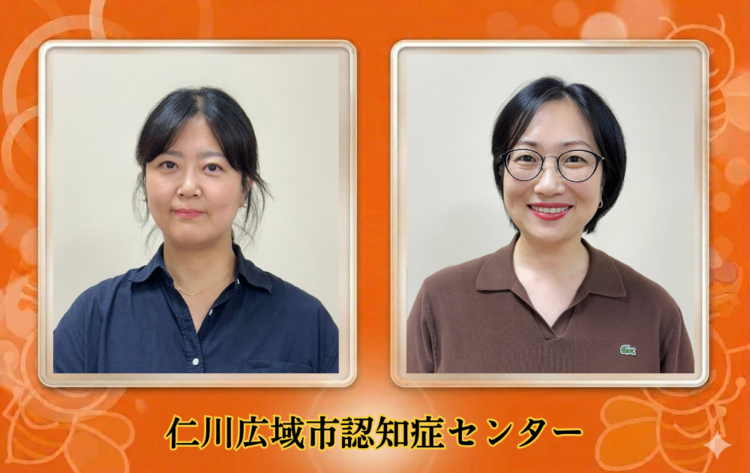
(Left) Mina (Right) Hyeshin
With the "Humanitude Sans Frontières International Conference" just around the corner, this is the third installment of our interviews with speakers. This time, we conducted an online interview with the "Incheon Metropolitan City Dementia Center," a pioneer in the practice of Humanitude in South Korea.
We spoke with Lee Mina (hereinafter referred to as Ms. Mina), who is the team leader in charge of planning, public relations, and Humanitude program at the center, and Kim Hye-shin (hereinafter referred to as Ms. Hye-shin), who is responsible for education as Korea's first certified instructor.
Incheon Metropolitan City is the only city in South Korea where the government has taken the lead in introducing Humanitude into medical and welfare settings, achieving numerous successes. We will explore the efforts and future aspirations of the Incheon Metropolitan City Dementia Center, from its outreach activities centered on free training at public facilities, to the changes demonstrated in the field through collaboration with universities, and its efforts to expand its activities to the private sector and local communities while overcoming the constraints unique to government agencies.
It all started with a documentary program. The enthusiasm of the residents motivated the "government-led" implementation.
—First, could you tell us about the role of the Incheon Metropolitan City Dementia Center and the background to the introduction Humanitude in South Korea?
(Mina)
The Incheon Metropolitan City Dementia Center is one of 17 regional dementia centers established nationwide based on the national law, the "Dementia Management Act." Its main duties include planning and researching dementia management programs tailored to the unique characteristics of Incheon City, as well as providing support to related institutions such as "Dementia Relief Centers" in each public health center and nursing hospitals to ensure smooth operations. Within this framework, Incheon City has focused its efforts on two specialized projects: "support for young-onset dementia patients" and "the introduction and operation of Humanitude."
The development of Humanitude in South Korea began in 2019. When the first international seminar was held, featuring Yves Gineste, the creator of Humanitude, and Miwako Honda, the representative director of Japan Humanitude Association, a documentary about it was broadcast on South Korea's public broadcasting station (KBS). This generated a huge response among medical and caregiving professionals and citizens, and inquiries poured in. As a result, it was adopted as a "citizen-participatory budget project" proposed by citizens, and its formal implementation under government leadership was decided.
During the difficult period caused by the COVID-19 pandemic, we conducted web seminars and other activities, and in 2021, we signed a Memorandum of Understanding (MOU) with IGM (Gineste Marescotti Institute). This agreement established a system for conducting a "four-day basic training" program for staff working in public facilities. After a preparation period for the training system, we began training in May 2023, and to date, we have held approximately 50 sessions with about 490 participants.
Changes on the ground proven through collaboration with universities
—You started the basic training program in May 2023. What changes have you seen since then?
(Mr. Hye-shin)
We trained certified instructors from 2022 to 2023. Currently, we have a total of four certified instructors: two at our center and two at the hospital, who are responsible for education.
In order to establish Humanitude in practice, we believed it was important to objectively verify whether it was truly effective. Therefore, we proceeded with data collection in collaboration with local nursing universities and hospitals.
As a result, individuals with dementia showed improvements in activities of daily living (ADL), and behavioral and psychological symptoms of dementia (BPSD), also known as peripheral symptoms, significantly decreased. At the same time, a synergistic effect was observed for caregivers, with reduced burnout (mental fatigue and burnout syndrome) and improved caregiving capabilities.
(Mina)
In addition to data, we also conducted a study comparing and analyzing before-and-after footage of participants on the first and fourth days of training. The study showed that those who initially showed resistance or rejection Humanitude had reduced their resistance and experienced a decrease in pain and physical discomfort by the fourth day. Such "visible changes" have also contributed to increased motivation among staff members to implement the method.
The pride of a "practical organization" that exceeds stringent standards, and thorough quality control.
—Are there any unique initiatives that Incheon City is implementing to manage the quality of care and maintain the motivation of staff?
(Mr. Hye-shin)
As part of the professional development program for certified instructors, João from Humanitude International visits Korea once a year to conduct a one-week refresher training course.
To further solidify the practice in the field, a system was launched in 2024 to award certification plates to "Humanitude Practice Institutions." The criteria for this certification are that "more than 70% of the staff in the facility have completed a four-day basic training course," and "there are staff members who have completed more advanced practical training." Currently, out of approximately 20 public facilities in Incheon, three facilities have met these criteria and been designated as practice institutions.
We don't just hand over certification plates and consider the job done. Based on a checklist we created adapted to the Korean context based on IGM (Gineste Marescotti Institute) certification standards, we visit the facilities at least once a year to monitor and manage the quality of care provided on-site. Last year, I conducted on-site training together with Ms. João.
The staff members on site take pride in the fact that "we are a facility that practices Humanitude" and they approach their work with that pride.
From early-onset dementia to supporting young carers: Humanitude weaves "new relationships"
--The Incheon Metropolitan City Dementia Center has been focusing on supporting "young carers" (younger generations who provide care for family members) from an early stage. How do you think the principles and techniques of Humanitude can be utilized in this program?
(Mina)
Incheon City has the highest rate of early-onset dementia in the country, and therefore operates a specialized facility. Tailored to the specific needs of individuals with early-onset dementia, it provides support not only for cognitive rehabilitation but also for returning to social activities, such as employment support. Last year, the city invited individuals with early-onset dementia from Japan to host a joint Japan-Korea policy proposal discussion forum.
In supporting families of young people with dementia, the challenges faced by "young carers"—younger generations taking on caregiving responsibilities—have become apparent. To prevent their isolation, we started managing a community this year.
What I realized then was that I was struggling not only with caregiving techniques and how to deal with problems, but also with rebuilding relationships—how to face and build a relationship with a parent who has changed due to dementia.
When considering new ways of interacting with family members whose relationships have changed due to dementia, I believe that the principles of Humanitude can be a source of emotional support for young people, and I would like to explore the possibility of using it to support young caregivers in the future if the opportunity arises.
Experiential public relations and unique awareness campaigns at the stadium.
—What are the challenges ahead, and what is important for continuing with Humanitude?
(Mr. Hye-shin)
When conducting training for on-site workers and their families, we emphasize the importance of "putting it into practice." We encourage them not only to acquire knowledge, but also to practice at least one care technique and experience the changes in the recipient's facial expressions and reactions. We believe that accumulating these small experiences is what improves the quality of care.
(Mina)
Furthermore, we are aware of the systemic limitations inherent in being run by a local government. Because we operate within a public budget, we are unable to provide the four-day basic training to private hospitals and facilities under contractual frameworks.
However, there is very high demand in the private sector. In a survey of approximately 300 people, 87% emphasized the need for care that respects human dignity, and over 75.7% responded that they would like to receive training.
Through trial and error, we are working to spread our methods to the private sector and local communities. One example of this is the "Dolbom Nuri Hall (A Hall for Enjoying Care)," a permanent information center located within the center. Here, welfare workers and families of people with dementia can visit and learn through the five senses, including Humanitude technique (seeing, talking, touching, and standing) and simulated experiences of being elderly.
Furthermore, to promote understanding of dementia throughout the community, we hold a joint event with the Korean professional baseball team "SSG Landers" every September to coincide with Alzheimer's Day. At the event, we conduct awareness activities about dementia on various themes each year, and as one of these initiatives, we have conducted a campaign with Humanitude as the theme. During breaks in the game, we used the stadium's large screen to introduce the gaze technique. Tens of thousands of spectators in the stands simultaneously made eye contact with the person next to them, and this unique public relations activity that involved the entire stadium had an impact on the local community.
For Humanitude to take root, it's crucial that it becomes not merely a "task" within the facility, but a "normal part of daily life." To achieve this, expanded administrative support is essential, along with the unified efforts of private organizations, families, and the entire community.
Message to participants of the international conference
--Finally, could you please share your expectations for the international conference to be held in Fukuoka, and a message for the participants?
(Mina and Hyeshin)
Despite differences in country, language, and culture, the reason we can all gather here like this is because we share the same goal: to provide care that protects human dignity.
I hope this "Humanitude Sans Frontières International Conference" will be a warm and supportive space where everyone can share their worries and struggles and encourage one another. I am sincerely looking forward to meeting all the participants as fellow partners in spreading compassionate care and working together to improve the quality of care.
[Editor's Note]
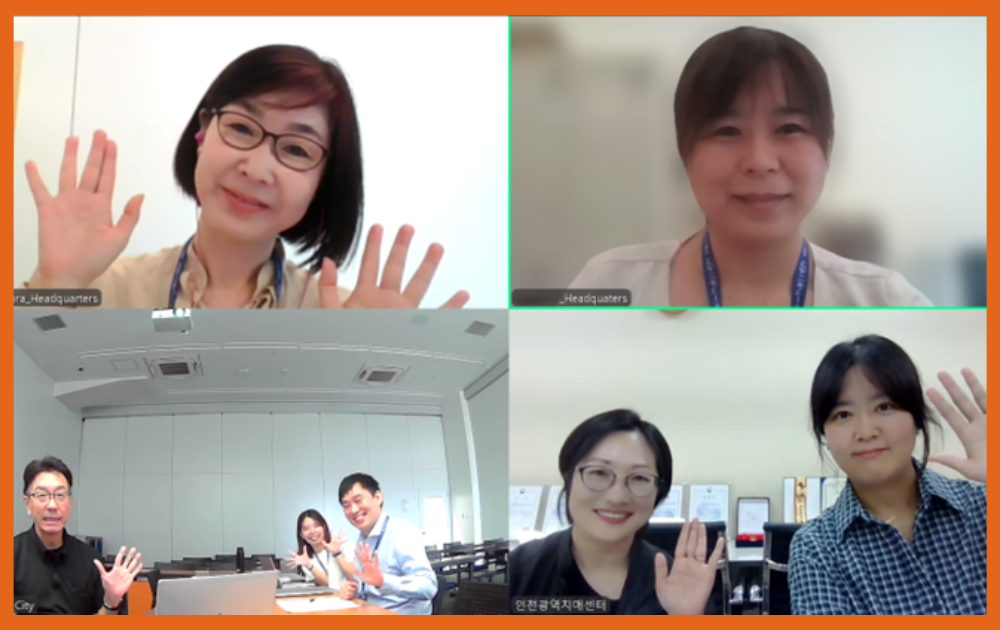
As the online interview began, numerous certificates of commendation and recognition lined the wall behind the two individuals displayed on the screen. It seemed as if the efforts of Incheon Metropolitan City up to that point had been directly reflected in these tangible documents.
From Ms. Heshin's words, "To make Humanitude a normal part of everyday life," and Ms. Mina's words, "To empathize with the emotional pain of young carers and to explore new steps," I felt a warm passion rooted in the community, unconstrained by administrative boundaries.
I am looking forward to hearing your valuable insights at the "Humanitude Sans Frontières International Conference," where we can share learning across national borders.